

I was perusing the Heavybit newsletter this week when I decided to wander over to their site and see what they were up to. I have a longstanding relationship with some folks there, have done plenty of business with their portfolio companies, and have even enjoyed the privilege of being published there on occasion. I found myself surprised by the H1 that greeted me from their homepage:
The Leading Investor in Enterprise Infrastructure
Am I crazy, or did it used to say something else? A few visits to the Wayback Machine showed me I wasn’t, in fact, crazy. As recently as May 13th of 2025, that same H1 read:
The Leading Investor in Developer-First Startups
As of today, the word “developer” appears twice on their homepage: once in the footer and once in a testimonial you have to scroll to find. The word engineer doesn’t appear anywhere.
I found this a bit jarring, since I weekly receive the “Dev Tools Digest” and, more importantly, “Dev Tools” was the core descriptor of their investment and acceleration focus for as long as I’ve been familiar with them (circa 2019). This was quite the positioning overhaul.
Evidence of a Category Murder
I reflected a bit on that, which prompted a few additional pieces to snap together, as if in one of my five-year old’s magnetic puzzle toys. A clear thesis emerged, but first, in no particular order, here are those pieces:
- Corresponding and catching up last week with a long-time contact in the developer marketing world, who casually mentioned how there’s no work anymore in developer marketing.
- Getting an email from an old friend with a bootstrapped dev tool business asking if the sledding was as rough for various HS clients as it seems to be for that business (yes, if you’re reading, it is).
- Subsequently realizing that I’ve heard versions of both of these things throughout the year making these most recent two far from isolated incidents.
- And finally, noting that as Hit Subscribe redesigns our site and offerings to feature a solutions menu, it didn’t occur to me to bother including landing pages for “developer tools companies” among the “who we help” or “technical content” among the “what we do.”
Now, I’ve long been skeptical of “developer marketing” as valid positioning, but as the owner of a company that has produced thousands of programming tutorials over nearly a decade, that last bullet is quite a notable omission.
And I wasn’t even making some kind of statement or engineering a pivot with that omission. I just realized that our ICP has naturally drifted away from including anyone that would describe Hit Subscribe’s value proposition as “technical content” or who would identify themselves as a “developer tools company.”
And so, my emerging thesis was this: developer marketing is dead, but ironically not by the hand we all assumed would eventually kill it.
Now before I pay off the gangster movie reference in the post title, I want to talk a little about how and why Hit Subscribe drifted away from this positioning over the last few years. Because in retrospect, I think what I perceived as moving up-market and diversifying was also a subconscious migration to higher ground ahead of an impending flood that we sensed.

Meandering to Higher Ground
If memory serves, I wrote the “skeptical of developer marketing” post about 2 years ago. At that time, we had moved up-market from our early days, either through engaging parent companies who acquired our clients, or simple referrals and enduring the procurement process of enterprises. In either case, we found ourselves (then, and more and more to this day) doing considerable work with late stage, PE, and public brands.
But the important distinction here is that these ICP organizations, without exception, had a dedicated SEO org chart with whom we were engaged.
This, for lack of a better descriptor, forced us to graduate from productized services delivered to whomever swiped a credit card, to bespoke-but-templated offerings for enterprises. This led to us changing our approach, our offering models, and even our org chart. It has now led to the long-overdue design of our “solutions” menu (stay tuned!).
And all of that, in turn, trickled back into how we approached and even qualified our book of business. We left dev marketing, not because we predicted its demise, but because the things that seem to be contributing to its demise make for poor business.
Realizations as We Naturally Left Dev Tools Behind
For the purposes of my post here today, there are some crucial takeaways from our positioning evolution.
1. “Developer Marketing” Starts to Wear Thin Up-Market as Companies Succeed and Grow
By the time an enterprise is large enough to have an SEO group, nobody picking us from an onboarded vendor pool cares about writing blog posts in markdown, the finer points of r/programming, or other inefficient and borderline-performative bits of dev marketing tradecraft.

Developer tools culture, including at large and mature enough developer tools organizations, evaporates and becomes, if anything, annoying and alien to our sponsors rather than table stakes for an engagement. (Some of you reading may have experienced this as employees leaving such companies as they grow.)
2. Developers are Really Just a Specific Flavor of IC Technicians
“Developer marketing” and doing SEO for it is really just a specific instance of the abstract base class of “SEO for niche technician audiences”.
Hit Subscribe had already traveled well outside of developer tools by 2024. But formally embracing non-dev-tools allowed us to stop considering those new clients one-off “key accounts” and to stop putting them in a separate non-dev-tools bucket, in favor of just having a throughline of “we can help with search visibility, even when the content is difficult to source.”
There are plenty of domains requiring niche content written by folks with expertise. And if you’re doing it right, the only meaningful differences are in tactics, not strategy, and sit squarely below the brief.
3. “Developer” Marketing Has Fragmented a Lot Over the Years
Most of our clients, even by 2024, while technical, were less dev tools and more adjacent concerns, like AppSec, data engineering, networking, observability, or similar. So abandoning a word-salad descriptor of all such companies, or of something reductive and specious like “deep tech” just made sense anyway.
Realizing we’d already left the space behind more than we might have thought, we were comfortable with the shift.
4. Companies Consciously Doing “Developer Marketing” will Almost Always Self-Sabotage HARD with SEO/GEO
And the final nail-in-the-coffin piece of learning on this front, to put it bluntly, is that early-stage dev tools companies (or similar) tend to make pretty bad fit clients for SEO and, these days, GEO, services anyway.

In the first place, those channels have long enough payback periods that many of those dev tools companies exit, zombie, or radically shift their GTM before they could ever expect to see meaningful results. And beyond that, especially with first time founders, they usually need so much education about the channel that my blunt advice tends toward “don’t bother with organic; focus on a GTM that you’ll be more likely to actually execute and not flat-squirrel yourselves.” (I could elaborate a lot more on this in a subsequent post for anyone interested but won’t belabor the point in this one).
So for us, it’s always been a classic two-sale problem in developer tools:
-
- We have to sell them on organic search as a lead generation channel.
- And then subsequently sell them on our approach and services.
Our ICP, by contrast, aren’t flailing around in their first rodeo. They all understand organic search as a channel, have had past successes, and simply need some combination of specialized execution and expertise to supplement their current efforts and to deliver wins for them.
The Rise of AI and the Surprising Non-Murder of Content and SEO
Everything I’m describing — the evolution of our business and realizations — happened from early 2024 until now. So it coincided with the rise of LLMs and the ability to for literally anyone to say “Heya, Chat Gippity, write me an SEO blog post targeting the keyword ‘best Java unit test frameworks.'”
Naturally, a lot of people, myself included, assumed that this could well kill the developer marketing niche and content marketing more broadly. In response to this concern, I shrugged and did a lot of R&D piloting the use of LLMs to fulfill content, though admittedly without the panache of the marketers and pop-up businesses out there using fancy terminology about context windows, neural networks, fleets of agents, and prompt tuning, as a 1,000+ word way generate a landing page to express “we have ChatGPT write blog posts.”
I just played around a lot in the form of applied experiments, generally partnered with guinea pig clients.
And my findings from doing this were interesting.
LLM content temporarily shocked the traditional market to a standstill a few years ago, but then the desire for good old fashioned human content doggedly persisted. A lot of purist buyers still don’t like the idea of generated content, but besides that, over the last 3 years, the hallucination danger has not meaningfully subsided.
So what winds up happening is that you either shrug and say “I don’t care if our company blog says it’s safe to eat a few rocks per day” or you do care about that, and you discover that it isn’t much less labor- or capital-intensive to have an LLM babysitter reviewing and marking up content than it is to just have a non-hallucinating human write the posts in the first place.

Mostly, the impact of LLMs on the content market has been to flood the internet with content that wouldn’t have existed without LLMs. The kinds of buyers that tend to rely heavily on generated articles aren’t choosing between “machine or human” but rather between “machine or we just don’t bother.” Humans writing content has, improbably, survived, and still drives demand across the board.
With the development of our Osiris offering, Hit Subscribe is fairly fulfillment agnostic, meaning we can design a program for you with dedicated human authors, a pool of guest contributors, your own internal staff, or your robot friend of choice. And the fact of the matter is that there’s way less universal demand for “robot friend” implementations than you might assume, even with reduced unit cost. Turns out a lot of people don’t want a company blog full of hallucinations about their domain’s equivalent of safe rock eating.
And so here you have our hero Carlito Brigante, ducking, dodging bullets, tumbling down stairwells, and successfully escaping the LLM mafia.
The Saturation and Obsolescence of Developer Tools

But boom here comes Benny Blanco out of nowhere — and I mean, nowhere!
Developer marketers survived the LLM onslaught only to catch a surprise gut shot from their clients running out of money.
It isn’t that developer tools companies, flush with money, want to spend that money on LLM content. It’s that developer tools companies are not, in fact, flush with money. And they’re not, in fact, buying any kind of marketing as they fight for survival or a much less promising exit than seemed possible a few years earlier.
As evidence of this, or at least a major bellwether, I invite you to look at Heavybit’s change in positioning. Or maybe the evolving value prop and eventual sale of dev.to.
I can also speak to it directly with enough relationship history not to be purely anecdotal. When I look at Hit Subscribe’s rolodex over the years, a lot of GA4 instances have gone quiet and a lot of domains are for sale. And, while startups are risky propositions across the board, the numbers look a lot more grim than they did, say 3, 5, or 7 years ago.
I am not a professional investor nor a market analyst, but it seems to me that one major issue that developer tools companies have likely faced is saturation and the introductions of catalogs and ecosystems to manage them. When we founded Hit Subscribe in 2017, startups were offering things like feature flags as a service, code completion, assorted productivity tools, etc.
These days it seems like any and all of those things would exist as part of increasingly large suites, sold increasingly as package deals. You simply can’t ask engineers to individually choose tens, hundreds, or thousands of disjoint tools to make them slightly more productive. The category is, in a way, a victim of its own success.
Plus if you want to talk developer productivity tools now, AI has sucked all the oxygen out of the room. What good is a tool that auto-completes the line of code you’re typing when Claude Code generates the whole line? Why have any kinds of plugins that speed up typing or small-scale refactors. AI is suddenly the alpha and omega of developer productivity tools, and developer buy-in is a moot point in the face of leadership saying “buy in or you’re fired.”
Developer Marketing and Tools are Casualties of Collapsing Developer Influence
And, speaking of which, the idea of marketing to software developers presupposes that developers are still worth marketing to. I would no longer bet on this modestly, let alone presuppose it.
This is going to sound like really weird take from anyone who remembers me writing the book Developer Hegemony almost a decade ago. For those not familiar, my core call to action was for software developers to migrate out of individual-contributor-hood in pyramid shaped organizations in favor of owning the 21st century means of production and calling the shots. It was, essentially, a call to action for claiming the primacy of developers as influencers and decision-makers.
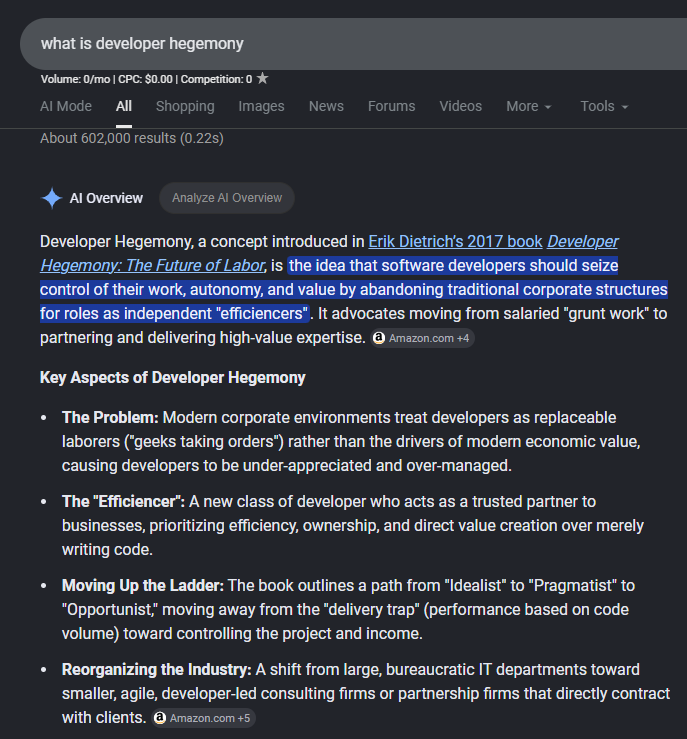
So it’s a bit of a weird reversal to now, somewhat cynically say that it’s probably not worth bothering to market to IC software developers. But truth be told, I don’t remember offhand exactly how much in the book I predicted what would happen versus calling out what I thought should happen.
In 2017, I called for members of the trade to resist corporate commodification in favor of making important decisions and calling the shots. This is (outside of indies and entrepreneurial programmers) largely not what the industry did, and commodification has come for it hard lately. Life moves fast in tech.
The reality of the situation right now is that software developers are mostly in the news for being laid off en masse and not rehired. And that’s when they’re not in the news, participating in interviews about whether they’re worried that AI bros are right and that their careers are over. The best path to salvation? Going along with the broad company mandate to “uh, use AI or whatever, figure it out.”
Does that sound like a largely empowered demographic, forcing its way into a buyer committee and exerting meaningful influence? Not at all. It sounds like the pre-enterprise-Silicon Valley days when engineers used whatever version control system some sales guy sold to their VP of IT over a game of golf, and nobody cared a lick what they thought.
Full, sad, circle.

What I Would Do
At the end of Carlito’s way — oh, spoilers, by the way. Anyway, at the end of Carlito’s way, it’s not totally clear that Carlito dies from Benny’s gunshot, though it very much seems like it. And I think that’s where developer marketing sits at the moment.
On one end of the spectrum, I could blow sunshine up your, well, you get it. I could say that you should just ride it out and your skills and past experience will find a home. But I don’t really believe that.
On the flip side, I don’t want to go totally fatalistic and scorched earth about “developer marketing is dead.” I mean, COBOL has been dead for 50 years and somehow it still hasn’t gotten the memo. So you can probably continue to grind out a living for a lot longer than most would think.
Bearing both ends of that spectrum in mind, here is what I would advise anyone in developer marketing, broadly, that asked for my take. Those asks doesn’t happen as frequently as they did in my DaedTech and YouTube Q&A days, but people do still wonder what I think every now and then. So if you’re still with me and in developer marketing, here’s my penny’s worth of thoughts.
As an IC Type
If you’re an IC in the space — an IC working for a dev tools business in content marketing or a freelancer doing similar — I’d start by brainstorming adjacent concerns that make use of your skills. You must have some combination of technical acumen and an ability to communicate, and both of those things still have value, if not exactly the same value.
I’d think about something like transitioning to sales engineering or perhaps being involved in creating media properties (e.g. as an influencer yourself or as part of some kind of broader and nimble content engine). Or perhaps you learn a slightly different, less-bubbly discipline such as marketing to mechanical engineers or people that do aerospace repairs or whatever. I think the name of the game here is flexibility and a series of mini-pivots to keep up with the market rather than something dramatic.
There’s enough remaining inertia in the space to keep the lights on while you probe slight changes of trajectory for validity and comfort.
As a Developer Marketing Services Business
I’d personally recommend a different tack for a services business in the space. If Hit Subscribe’s primary focus had remained developer tools and marketing the last few years, I would probably have pulled the rip cord and gone back to management consulting. In services, my advice hews more towards “burn it down,” at the risk of sounding nihilistic.
But as anyone owning an equity business knows, one doesn’t simply “burn it down,” for the most part.
Instead, I’d ruthlessly audit the business for what it does well besides “content with angle brackets in it” and create a matrix to score and rank other possibilities. For Hit Subscribe, this would have historically included things like “SEO services, large bench management, back-office operations at scale, CMS operation, etc.” I would have taken those things, in groups, or individually, and started to weigh their merits as the primary focus of a different business, with different offerings and a different ICP and then set about methodically pivoting.
As a Dev Tools Business
Last, I’ll conclude with something that’s probably furthest from my lane, though, as someone who has built software, worked in software, and who now occasionally acts as a fractional CMO, I feel as though my opinion has at least a little weight. And, of course, this is going to depend heavily on the nature of the developer tool in question.
But broadly speaking, I would give serious consideration to abandoning a PLG and developer champion motion in favor of sales-led and potentially enterprise focused. I would also look heavily for potential channel partners, brokers, and platform resellers or perhaps VAR type partnerships. The common theme is “forget mass market appeal and focus instead on making fewer, highly strategic, sales.”
I say this both because it seems as though the pendulum is naturally swinging this way and also because this is a much better fit for a business bailing out the boat and cutting headcount. You don’t need a website with millions of visitors, armies of SDRs, and an entire marketing department to win business here — just a determined founder, a good value proposition and some sales chops. Your partners and buyers will do the mass-market selling for you after you close them.
Eras Often End Quietly

Heavybit (to my knowledge) didn’t make some kind of massive statement that it was making a serious adaptation or pivot. It just changed with an H1 on the site. And, in retrospect, Hit Subscribe did something similar: a drift and a blog post. Well, I guess now two blog posts. Likely in those and other cases, it’s a mix of subconscious adaptation and the occasional intentional reframe.
I think that’s the move broadly here, for all involved, as well.
Developer tools and developer marketing were fun spaces, particularly in the heady days of both being new. The ocean was blue, the opportunities endless and fascinating, and I personally loved the ability to do technical things, write about them, and have a little fun along the way.
But the moment has passed. Not some kind of definitive way, but with a series of slow, sliding evolutions into non-fit, saturation, declining effectiveness, and general broad fatigue. That probably calls for a little appropriate grief, a little time to mourn, a little adjustment, and then a general “welp, let’s try something else.”
And who knows. That something else may be fun. We may even make it to the Bahamas this time.
Interested in More Content Like This?
I’m Erik, and I approved this rant…which was easy to do since I wrote it. If you happened to enjoy this, I’ve recently created a Substack where I curate all of the marketing related content I create on different sites.
Totally free, permanently non-monetized, and you’re welcome to sign up. Click here or fill out the form below:
