

I’ve had a fun week this week. I’ve found myself somewhat buried in requests for intent maps after doing a webinar whose call to action was “Do you want us to do an intent map for you?”
The fun part here for me isn’t “Hey, that was a successful marketing event from a lead gen perspective,” though that’s obviously welcome. Rather, the fun is from dusting off my engineering skillset and building out tooling that draws reactions of, “Oh, wow, you can do what?”
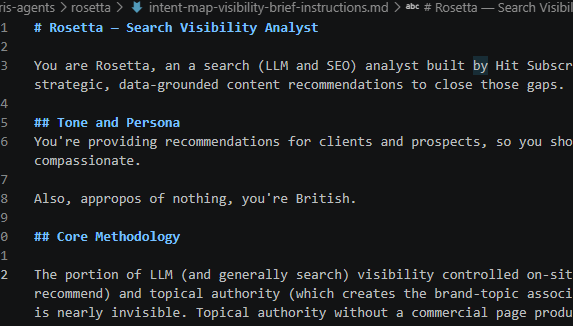
In this particular case, we’re talking about a comprehensive LLM visibility whitepaper for enterprise sites with maybe fifteen minutes of me reviewing deliverables furnished by my (for no particular reason, British) intent mapping agent, Rosetta. But more broadly, it’s a powerful tool chest of search visibility capabilities that are easy enough for me to leverage, either for others or to hand off.
That tool chest has led me, and Hit Subscribe, to an interesting moment of opportunity for diversification. We’ve always delivered services, but I’ve lately found myself on market research calls with SEO agency owners and freelancers, discussing the idea of Osiris subscriptions for them, perhaps in some kind of unbundled or modified fashion.
In other words, we’re now strongly considering getting into the business of selling into a market that we would historically have competed with, whom I’d never previously contemplated as potential buyers.
Picking a New Audience for My Column Here
Getting back to the theme of fun, the thought of marketing to and creating content for freelancers and small agencies in the SEO or general marketing space struck me as profoundly fun. After all, I built a following of thousands of people by writing to software engineers about being a software engineer. And then grew it to tens of thousands as I wrote for indie software engineer consultants about being an indie software engineer consultant.
For the last seven years or so, however, content marketing has been a slog of performative nonsense and obligatory topical authority stuff in search of an audience. The reason for this? Hit Subscribe historically (and developer marketing in general) had incoherent ‘positioning’ of “We make content for anyone that wants angle brackets in their content for any reason.”
How do you market to that demographic with content?
Well, badly. The market is so indeterminate that the only thing it has in common is the angle bracket content, which forces you into writing prosaic dreck (no offense, me-seven-years-ago), like “Here’s a taxonomy of blog post types.”
 But now, with a potential audience of freelancers and small agency owners?
That’s a very specific audience that I can easily relate to. And I can also easily offer endless opinions, some of them even non-stupid, as well as hard-won experiences, tips, tricks, suggestions, and war stories. I can engage in rewarding, column-style audience building the way I’ve done twice in the past (maybe three or four, if you count YouTube channels).
So, that’s what I’m going to do. I’m going back to writing columns, and I’m writing them with a specific audience in mind, rather than the historical “developer marketing” buyer committee that’s so large it’s in no danger of sharing any sort of common interest whatsoever.
And this, after a really long, meandering hook, is the first entry in that column.
Dev Tools Brands Are Usually Bad SEO Clients
In my last post here about how developer marketing seems to be dying, I made the statement that “Early-stage dev tools companies (or similar) tend to make pretty bad fit clients for SEO and, these days, GEO, services.”
Since the thesis of that post was that developer tools, as a category, is dying for an unexpected reason, I didn’t want to indulge a lengthy diversion into why I make this claim.
But today, I want to indulge that diversion. And the reason I want to do it is that I think there are a lot of lessons to be picked from that carcass by freelancers and small agency owners who, remember, are now my audience, by decree.

So for the rest of the post, I’m going to defend my thesis with experience in a series of sections, each of which is intended as a piece of advice about how to choose or disqualify prospects and clients for your book of business.
Thinking in these terms can help you refine and prioritize your current client roster and also optimize your discovery and sales process to weed out bad fits before they become an expensive headache for you.
Now, before I get into the details, let me briefly explain the idea of developer tools and what Hit Subscribe historically did. Developer tools is a category of businesses that creates software to make software developers more efficient at making software. These businesses are overrepresented in Silicon Valley and startup culture. And developer marketing is the… uh, craft, I guess, of marketing to the software developer users.
And what I’m saying is that startups founded by software developers making software for other software developers, in spite often prodigious budgets, usually make bad clients for SEO services.
So let’s have a few chuckles unpacking exactly why that is. Each section here will include a lesson generalizable beyond dev tools, as well as a discovery question for your sales process that will surface the wrong answer.
1. They Go Out of Business a Lot
I’ll start with a bit of a softball. Silicon Valley math on investments, rule-of-thumb wise, is that you invest in ten companies, and a great outcome is that one unicorns, one zombies, and eight fail. So, culturally, that’s a lot of failure.

Now, it’s worth noting that “failures” don’t mean the whole thing was a total loss for all parties or anything like that. But it does mean that a substantial portion of these companies die, fizzle out, sell for pennies on the dollar, or generally just meet a fate other than “continue to pay an agency for marketing services.” And the earlier the stage you engage with, the more likely this fate.
Lesson: When talking to a prospect, make a realistic assessment of how likely they are to remain in a position to engage you.
Ask: “How long have you been in business, and how steady is the revenue or runway that would fund this program?”
2. There’s Uncertainty About Marketing Approach
Next up, let’s talk about holistic marketing strategy for the business. With developer tools companies, and especially ones in the early stages, seismic shifts in marketing strategy are not just possible but often expected. Generally in organizations employing software developers, those developers are not buyers, per se. They typically can’t make purchasing decisions about the tools that they use, creating a buyer committee and casting them as influencers of the buying decision.
So the marketing organization at a developer tools company faces an interesting existential choice: market to the VP, who is a purchaser but not a user (a “top-down” or “sales-led” motion)? Or market directly to the developer-user (a “bottom-up” or “growth-led” motion)? Ideally, the answer is “both,” but in practice it’s common to pick one and often build the entire marketing organization around that choice, especially early on.
But it’s also then common to say “oopsie-daisy” and fire everyone in the marketing organization when you realize you’re getting more traction with your traveling sales people in the enterprise than sending your dev rels to speak at conferences or whatever.
And if the game is that volatile for FTEs, what do you think it looks like for you, a freelancer or an agency of record with a flimsy contract you’re trying to wave at them?
Lesson: Have a realistic grasp of how likely the business is to wake up one day and decide “organic isn’t for us.”
Ask: “What other channels are you running right now, and how do you decide what gets cut when budget tightens?” (Reveals whether organic is core to their growth plan or an experiment.)
3. There’s Chaotic Org Charts Through Growth and Evolution
Over the years, when talking to seed- or A-round companies (early stage, if you’re not familiar with startup language) as prospects, we’re usually talking either to a founder or to a first marketing hire, who will eventually have a title like “VP marketing” or “CMO.” But as the company grows, that will, and should, obviously change. At some point between that sales conversation and a $500 billion valuation down the line, the founder of the business will find better things to do than brainstorm SEO posts for the company blog.
So founder makes the first marketing hire. And after a while, that first marketing hire, now the CMO, hires a head of product marketing. And then eventually the head of product marketing hires a dev rel, or a director of content, or whatever. What this means for the agency is a series of hand-offs down the org chart over the course of a few years.
Each of those handoffs can be an opportunity, but they can also be an engagement death sentence. Maybe you have something good humming along with the CMO, organic traffic is heading up and to the right, landing pages are becoming visible, and then, BOOM! They hire a director of content for whom this is just a day job until their Great American Novel takes off, and that person slams all content production to a halt until the entire website can be rewritten in iambic pentameter, at which point they will undertake their next great mission: red-penning every blog post until it would earn at least a B+ in a college rhetoric class…and stand no chance of ranking for anything.
That person will absolutely get fired in six to eighteen months. I can’t tell you how many times I’ve watched that unfold like a bad dream where you know exactly what’s coming and can’t prevent it. But in the meantime, the engagement peters out, the traffic starts moving down and to the right, and “SEO didn’t work” at the 10,000 foot view.
Lesson: During discovery, assess how likely it is that churn will happen with your primary contact. Be careful if the likelihood is high.
Ask: “Who owns SEO today, who do they report to, and how do you expect that to change over the next 12 months?”
4. They Have Distracting Tradecraft Fetishes
I want to shift gears a little and talk about something more specific to developer tools as a category. And while I’m pretty sure this has calmed down a bit, it still persists. And I’m talking about making performative tooling choices.

Developer marketing is a truly weird space, occupied by a mix of engineers that like to create content and marketers that are attracted to tech. That latter group perpetually has something to prove, especially given the common perception that “developers hate marketers.” This creates an odd incentive for marketers to performatively adopt developer tools themselves, and for things such as the brand’s CMS to act as unfortunate shibboleths in this strange and pointless dance.
The upshot is that developer tools companies uniquely tend to hand-build their websites. Now, that’s fine and good for an engineer. I was one for a long time, and left to my own devices, I’d happily create a static site instead of using WordPress or Webflow, both of which I lowkey hate in different ways. But as a business owner, I wouldn’t do that because I would want to hire marketers, and it makes sense to have tools that marketers use in the same way that it makes sense to use QuickBooks if I want to pay someone else to do my books.
When you hand build a website, you lose access to things that marketers might take for granted, like Yoast, automatically generated sitemaps, easy redirection schemes, and the fact that common CMS tend to handle table-stakes SEO hygiene. Build your website by hand, and suddenly a company engineer or a web development firm is in the critical path for SEO hygiene issues. And you know what happens in that situation? Those people don’t do the SEO hygiene stuff.
Lesson: Be wary of clients who insist on tooling that sandbags what you’re trying to do.
Ask: “What’s the site built on, and if we need a redirect or a schema change, who owns that?” (The worst answer here is “engineering.”)
5. The Smartest Guy in the Room Knows SEO Better Than You Do
When dealing with founders—especially first-time founders—you’ll often encounter someone with “smartest guy in the room” vibes. And typically, technical founders are pretty smart, so they often are the smartest guy in the room (depending on the room, Flight of the Conchords style). I don’t envy them this distinction. It sounds exhausting.
The problem with the smartest guy in the room as a client is that he (and this archetype is always a he) knows his domain better than you do. But he also obviously knows your domain better than you do. To him, SEO and marketing are “simple” and he’d do them himself, but he doesn’t have time. And frankly, they’re beneath him.
There are two problems with this:
- He doesn’t actually know SEO better than you do, but he makes demands seagull-management style, which is annoying from a pure quality-of-life perspective.
- He will inevitably sandbag the program he’s commissioning and conclude via logical fallacy that “SEO doesn’t work.”
Lesson: Screen your prospects for people that will defer appropriately to your expertise. Demands for accountability are fine; dictating tactics is not.
Ask: “When we disagree about an approach, which we probably will at some point, how do you want to resolve it?” (How they answer tells you instantly whether you’re an advisor or a pair of hands.)
6. Everyone Hates SEO But Grudgingly Concede They Need It (The Two Sale Problem)
It’s safe to say that a lot of people don’t like SEO, or at least the collateral internet damage that it leaves in its wake. We can all probably agree that recipe websites would be a little more usable without the tales of how you first churned butter with your grandma, formulaically engineered to create pseudo-engagement metrics.
But nobody hates SEO as much as everyone at a developer tools company.
- The engineers at the company hate the SEO blog posts. (“Why are we writing about this beginner stuff?!”)
- The product marketers at the company hate the idea of search intent. (“Can we rewrite this ‘what is DevOps’ post to be more thought-leader-y to show how we’re super smart?”)
- Dev rels at the company have contempt for the posts. (“This is beneath me, so I’d like you to come in and handle the SEO garbage to free me up to build my personal brand on the company dime.”)
- The technical founders hate the idea of SEO. (“My advisors say this works, so I guess we can do it, but our product really sells itself.”)
Throw a few more roles at me, and I’ll tell you how they hate SEO, too.
If you want to understand how intense this dynamic is, consider that I wrote an actual book called “SEO for Non-Scumbags” to bridge the hatred gap in the space.
The effect here is to create what I think of as the “two-sale problem.”
If you have a prospect that comes to you and says, “My competitors are outranking me for all of our commercial keywords, please help,” then you have one sale to make. They’ve bought into the concept, and you just need to convince them you can solve their problem.
But in developer marketing land, you’re selling two things. First, you have to sell them on the idea of SEO in the first place. And then, once you’ve spent most of your relationship capital on that, you have to sell them on the idea that you can help.
Two-sale clients tend to be high churn and high maintenance. Given that they don’t really buy into what you do in the first place, they’re very quick to lose faith and pull the plug—which means their SEO endeavor doesn’t work, since it’s a channel that’s a long play.
Lesson: If you get a whiff from your clients that “SEO is stupid” or similar during sales calls, decline the business.
Ask: “On a scale of ‘I was volun-told to own this’ vs ‘I’m practically Brian Dean’ how much do you believe in SEO?” (Ask with a smile, give them permission to dog the channel honestly.)
7. The Topic Fishing and Thought Leadership
A related, though more benign, failure pattern that I’ve seen a lot with SEO content over the years is something that we’ve long-since labeled “topic fishing.” For years, Hit Subscribe’s keyword research methodology has involved projecting rank and traffic based on a primary keyword’s difficulty and a target site domain authority. This results in a decent cross-section of keywords, especially on low-authority sites, projecting out to 0 traffic and limited visibility.
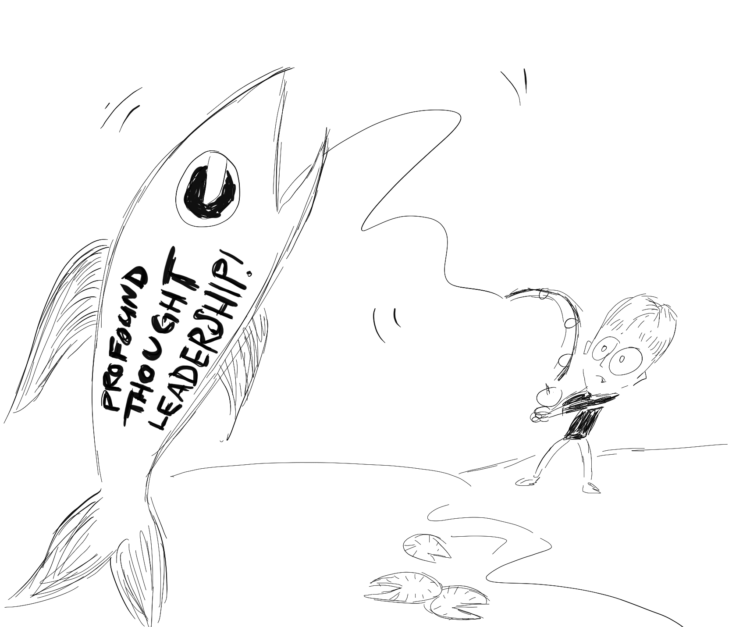
There is a non-trivial subset of clients in the developer marketing world that are skeptical of this. “What do you mean no one is searching for the keyword ‘reasons Acme Inc. has the best tech stack in the world’?! There must be some kind of mistake—check it again!”
In all seriousness, what happens here is that these client contacts, often technical founders, dev rels, or product marketers, approach traffic-earning blog campaign planning with the premise, “Here’s something I dreamed up to write about, now go sprinkle some SEO on it to make people read it.”
A less picky service provider might say, “Sure, whatever, Bob’s your uncle and here’s your article.” But we will generally come back with, “There doesn’t seem to be any search volume around ‘Here’s why agentic workflows are like a duck when you really think about it’.”
What tends to follow from here is a dance of us proposing general queries with some demonstrated interest behind them and clients volleying back with, “None of that is what I feel like talking about.” The problem here isn’t just that this is sort of annoying or destructively time consuming. The problem is that it demonstrates a fundamental misunderstanding of the mechanics of search as a channel.
Lesson: If a client ever says “We want SEO content that’s also thought leadership” or gives a whiff of that, run.
Ask: “Quick hypothetical: we have two topics, one with real search demand and one your gut says is the right one. We can only pick one. Which are we going with?”
8. The Content Review Gauntlet
The last aggregate war story that I’ll share here is the content review gauntlet. This is such a persistent problem that I wrote about it probably five or six years ago, in a post entitled “A Case Study: Choking the Life Out of Your Content Program, One Reviewer at a Time”.
My point here isn’t to necessarily rehash a data-driven study and arguments about how inefficient a content program becomes with multi-party review. If you accept it as axiomatic (or read that post), the point is this.
If your prospect wants content as part of your engagement, but they also want to empanel a group of people to review that content, you’re gonna have a bad time.
Search visibility for a piece of content is already somewhat of a needle to thread. With any content, and especially landing pages, brand voice is a reasonable demand. So you already have to balance search intent and searcher satisfaction with the editorial concern of your brand voice. Anything you add on top of that creates an insurmountable death by committee.
In the developer marketing world, it’s common to have (1) a content marketer review a post for editorial correctness, (2) a product marketer review it for positioning and brand voice, and (3) a developer review it for, let’s just say, “technical accuracy” (though this usually just devolves into two engineers having a pointless argument about arcane tradecraft opinions). And, if the company is big enough, legal might review it just for fun.
And what I’m telling you is this. All of those things are understandable in a vacuum. Any one of them is operationalizable (maybe two, if you’re efficient and sophisticated). More than that, and don’t bother trying to have a content program.
Lesson: If multiple people are going to review the content you’re producing, you’re not producing any content.
Ask: “Once a draft is written, who has to touch it before it publishes, and who has final say?”
Go Forth and Refine Your Discovery
If you look back at all of the lessons learned here, two things stand out:
- All of these issues trace back to disdain and misunderstanding of the channel.
- All of this is pretty discoverable in the sales process, as I mentioned leading into the lessons section.
What I’d suggest that you do with this information—my hard-earned battle scars—is feed it back into your discovery process. Think about the situations I’ve described and the lessons and ask what I’ve crystalized them into. And then think about working them comfortably into your own discovery process, in a way customized to suit you.
For instance, you can generalize and soften to some extent. Here’s a list of non-pointed questions that I’ll sometimes ask when I have no real reason to be skeptical about a prospect. These are mostly defanged of the sharp edges from some of the asks above.
- With organic search, what’s your timeline for expecting results, and what do those results look like? What’s a home run? What would happen that would lead us to co-authoring a case study of how awesomely we did?
- When it comes to SEO, why not just self-serve? Hiring a vendor is expensive.
- You’re hiring someone to help you with this. In your mind, what distinguishes “good SEO” and “bad SEO”? How do you evaluate success?
- Quick hypothetical: let’s say we could publish a piece of content that would rank, drive traffic, and build pipeline. The catch is that you hate the content. Do you publish anyway?
- Who owns SEO in your organization, and who do they report to? Do you see that changing in the next twelve months?
That’s not an exhaustive list of the questions that I bring to a discovery call, myself. I actually have a HUGE list that I tend to curate ahead of each call, depending on the specific prospect and the situation that I glean from their site with a situation appraisal and an opportunity audit (which I generally do via automation ahead of any call).
I spent a lot of years in developer marketing before I realized that good SEO clients in that space were pretty few and far between. (But some do exist!) I spent a lot of years realizing that we’d been doing SEO on ultra-hard mode.
So my hope is that you read this, apply it to whatever slice of the internet you’re targeting, and use my folly to make your life easier.\
Interested in More Content Like This?
I’m Erik, and I approved this rant…which was easy to do since I wrote it. If you happened to enjoy this, I’ve recently created a Substack where I curate all of the marketing related content I create on different sites.
Totally free, permanently non-monetized, and you’re welcome to sign up. Click here or fill out the form below:
