

I was on the fence about posting this over on DaedTech, since it’s a little rant-flavored, but I landed on putting it here, where I’m speaking to an audience of freelancers and agency folks. I actually do think what I’m about to lay out is an actionable financial planning tactic for agencies, freelancers, and small orgs in general. And maybe we can have a little snarky fun along the way.
I received this email from Atlassian, who, a while back, purchased one of my most cherished B2B tools: Loom. I use Loom constantly, and I’ve historically loved it. But now, obviously, it’s time to move on.
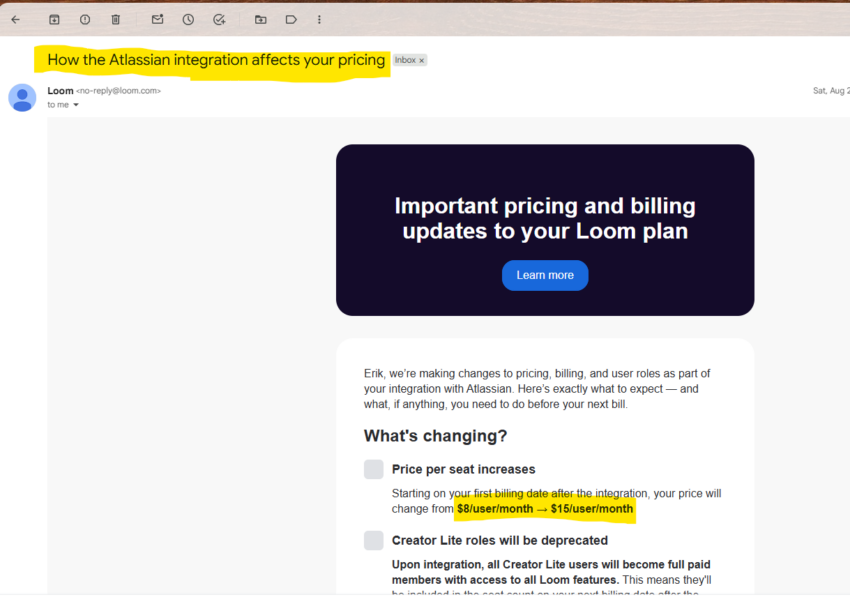
That might seem like a dramatic overreaction to the email, or at least a little glib. $8 to $15 per month (or $24 to $45 for the number of seats I think we have) is at most a minor annoyance for a business that wants to keep using a valuable tool. So what gives?
Well, what gives is that I’m not reacting to the price — I’m reacting to the extraction pattern. I’m reacting to the inevitable fate of Loom. And I’m reacting in a predictable enough way that I realized that I could schedule my reaction to enshittification. In fact, I could even budget for it, and I’m going to riff on that idea in this post.
The Fate of Loom: Funnel Asset for Enterprise Sales
Let me explain the Loom situation in a bit more detail to justify why I think switching away from it is a simple, pragmatic inevitability. After all, I’ve been down this road with another formerly-beloved, and largely-abandoned tool: Trello. Atlassian has acquired both tools.
Atlassian’s bread and butter is selling project management tools into the enterprise. Trello and Loom, on the other hand, have historically had much wider user bases, so there is some overlap, but not a ton. At least not initially.
Functionally speaking, an enterprise using Jira and Confluence is a much better, more important customer than a freelancer’s freemium interaction with Trello for keeping track of a todo list. So much so that I would argue Trello and Loom are more valuable to Atlassian as marketing assets for their core business than they are as standalone businesses in their own right. And everything about the behavior of these tools, post-acquisition, supports that hypothesis.
From here, I don’t think it’s a huge leap to say that Trello and Loom users whose behavior indicates they’re a qualified lead for the core business are more interesting to Atlassian than other users. And I also don’t think it’s a leap to say that the feature roadmap, support behavior, and pricing of these businesses will, and from their perspective, should, accentuate that distinction. Funnel the qualified leads in and gently invite the unqualified ones, like Hit Subscribe, to piss off.
Forcing the Non-Qualified Leads off the Platform

I imagine a lot of former Trello users can relate to what I’m about to say. When I started using Trello, you logged into Trello and used it. But post-acquisition, Atlassian rolled out some kind of unified login experience that gradually forced you to create an Atlassian account. The result is a confusing coexistence of legacy and current credentials that occasionally turns logging into Trello into an infuriating 10-minute side quest.
I’m looking forward to that same mildly infuriating experience now with Loom, sooner or later. If I were a Jira user, this would likely be pretty convenient — hey, I’m just magically auth-ed into these tools now! As a non-Jira user, it’s awful. So if you go back and read the email I received from Atlassian, here’s how it actually lands with me.
Good news, Loom user! Now that you’re involuntarily part of the Atlassian ecosystem, not only will things be generally worse and your login experience Kafkaesque, but it’s twice as expensive! Don’t like it? Sucks to be you!
You might say I’m being overly cynical, and I can admit that I’m frustrated in what I see to be the inevitable nerfing of one of my favorite B2B tools, but even the most benign and charitable read of this has the price doubling, the product roadmap radically altered, and new stuff I don’t want. So in the blink of an acquisition, Loom became more expensive and less useful for my business.
Whether you refer to this as “enshittification” or “extracting value out of locked in users,” however, I’d say planning for and around it can look the same. And there are levers to pull, which is what I’ll discuss shortly.
But to close the loop on whether I was overreacting to the email or not, I was not. That’s because my worry isn’t the price increase or the email itself. Instead, the email served as a reminder that, since I’m not an enterprise user, the company who owns Loom no longer cares about having me as a Loom customer. And that’s an unsustainable situation in which to be a customer.
Thinking Timelines
Elided from the screenshot above, and to Atlassian’s credit, they’re giving me plenty of notice. The price increase doesn’t actually hit for 7 months, which is plenty of time to plan around a relatively nominal change in raw dollars.
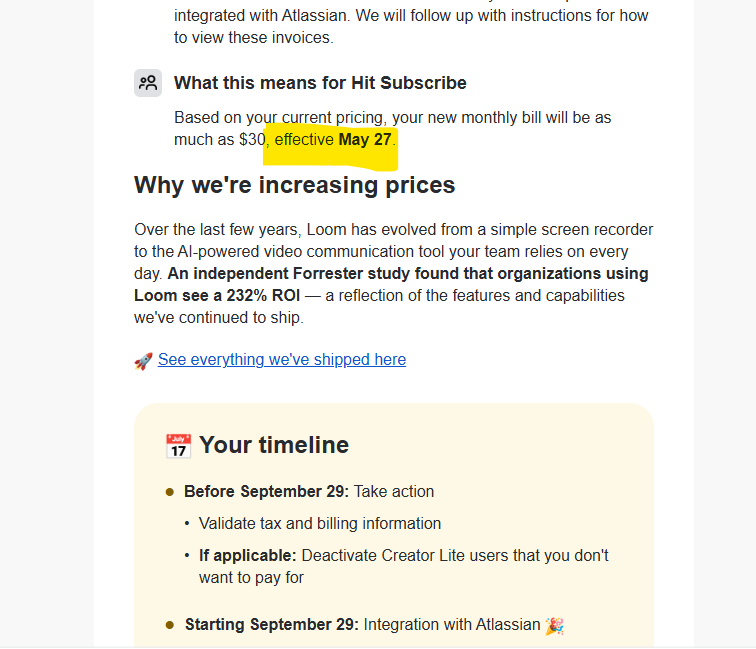
You can also, if you’re interested, go read their rationale for the price increase. It’s a mix of every business’s “we built a bunch of Slopware nobody asked for and someone has to pay for that”, a few genuine value-adds from the historical roadmap, and a bunch of Confluence and Jira integration that would only appeal to qualified leads using Loom.
So what you have here is a pretty classic acquisition and extraction move, laid out over a fairly gradual timeline. Atlassian seems even more benign when you consider that they acquired Loom in late 2023 and have, other than the janky login stuff, left the thing pretty much alone and left me to remain as a happy user.
However, I could have foreseen and predicted the extraction, increases, and altered feature roadmap all the way back in 2023. And I could have planned for it.
And, in fact, I’m doing just that with Airtable. Airtable was recently acquired by a company famous for extracting hard and fast (layoffs, eliminating free tiers, raising rates, etc). In the three weeks following that announcement, I actually completely migrated Osiris away from using Airtable as a combo-GUI/backend, removing the only critical dependency we have there. We’ll plan to take a more measured approach to the rest of our collaboration but are hoping to be Airtable-free by the time the deal goes through.
Enshittification Mechanics
I don’t want to belabor the point here, but it’s worth understanding why acquisitions give rise to this sort of thing. You can read in detail Cory Doctorow’s take on enshittification and read more about the mechanics of it in general. But that’s a description inextricable from social commentary.
 To give it a more neutral take, it’s simply the idea of extracting more value (money) out of existing assets. In and of itself, there’s nothing inherently wrong with that. It’s what a freelancer does after realizing they’re “under-charging” and that clients would pay more. Raise rates for the same deliverable, extract value via leverage.
Where things start to become much grayer is where tactics around doing that start to involve taking advantage of (or creating) massive switching costs and the use of dark patterns. I’m not going to weigh in on this too much, since this post isn’t about whether this should happen, but about sharing an idea for how to handle it.
So for our purposes here, understand that acquisitions are usually followed by the acquiring party engaging in value extraction — grabbing money the original company was leaving on the table.
And you should also understand two more things about extraction:
- It will work on you in direct proportion to how locked in you are, and how expensive it would be for you to pursue an alternative approach.
- The acquiring party often has to raise rates because the purpose of an early stage company in venture-land is to gain users, not to be profitable. So startups will often offer unsustainably low prices to acquire users (think Uber) knowing that eventually they, or an acquirer will have to pay the piper. tl;dr: pre-extraction offerings are usually unsustainably cheap.
Being Anti-Extractable
With this in mind, let’s think about what it would look like to build a business that was immune to, or at least very resistant to extraction/enshittification. If your goal were to deal with this as little as possible, how would you handle it?
The most naive suggestion would be “don’t do business with startups.” And while I don’t actually recommend that rule, its extreme formulation carries an interesting lesson. When you’re doing business with startups, you need to be aware that the offer is likely too good to be long-term true, and also that there will eventually be a piper coming to collect his pay.
Another important aspect of avoiding this fate is to look at each SaaS subscription on your expense sheet and think about what you would do if it 2x-ed or 10x-ed its price. If the answer is “we’d be doomed,” that’s no good. If the answer is “meh, we actually did a trial with one of their competitors a few months ago, so no biggie,” you’re in better shape.
So an anti-extractable business looks heuristically like this:
- Aware of where in the extraction lifecycle its vendors are.
- Aware of the magnitude and complexity of its dependencies.
- Able to switch nimbly to alternatives in the face of an extraction power play.
- Minimally dependent on vendors in danger of becoming extraction farms.
How do you become a company like this? Well, I have an interesting hypothesis that might make it easier than it sounds with a relatively simple accounting trick.
Enshittification Accounting: The Mechanics

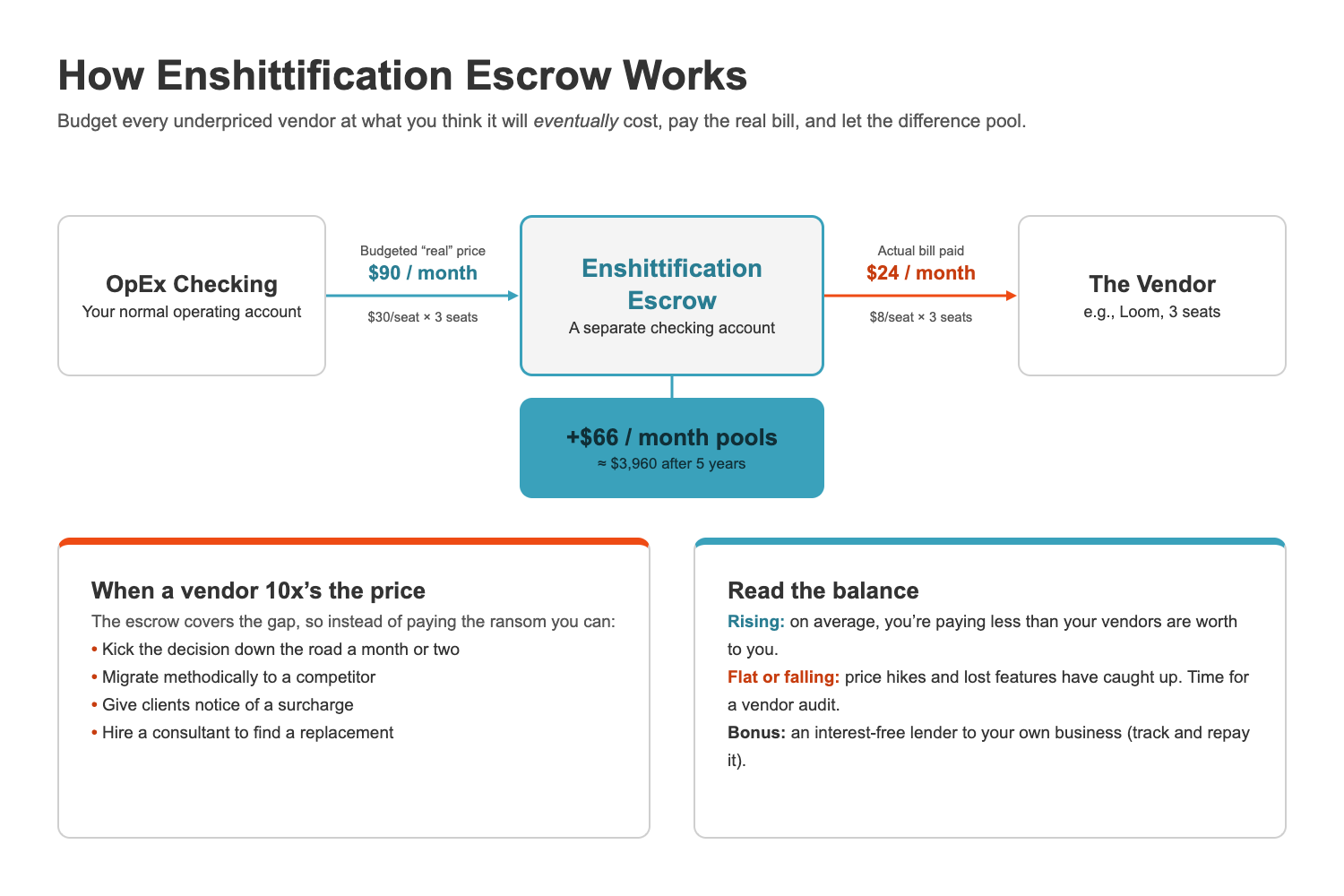
Here’s how I could see this working. You price SaaS and services based not on their introductory discount or current rate, but on an estimate what you think the eventual market price would be. This becomes your budget for that thing.
So, for instance, take my Loom subscription. Back when I started paying for it, probably 5 years ago, I could have said, “$8 per month seems unsustainably cheap for this. I imagine that for this to be profitable, it should really cost something like $30 per month.” (Ignore for the moment how one would arrive at that figure — I’ll get to that). This means that my budget for video collaboration is $30 per month, per seat.
That also becomes what I pay, through a trick of accounting.
That’s because I create a checking account, called, say, Enshittification Escrow. And then I set up a monthly transfer from OpEx checking to Enshittification Escrow for $90 (I think we have 3 Loom seats), which means I’m “paying” the full, sustainable price for Loom. I then also pay the $24 per month Loom bill out of the Enshittification Escrow account. So I’m transferring $90 per month into this account, while paying $24 per month out of it, assuming Loom is my only enshittification candidate in the beginning.
The effect that this would create would be money pooling in the escrow account. To be precise, after 60 months of this, I would have amassed $3,960 of surplus. Now, imagine the impact of doing this across a variety of underpriced offerings. For me, this would have included Airtable, Loom, ETL solutions, SEO tooling, API credits, and more.
 The “Macro” Economics of Enshittification Escrow
To be clear, this is NOT primarily a savings play. The goal isn’t to trick yourself into saving money, which genuinely makes little sense for a business deploying capital in order to profit and grow.
Rather, it is primarily about creating optionality and a buffer for smooth operations.
To illustrate what I mean, let’s swap out a trivial example like Loom in favor of something more complex, like Airtable. Right now our Airtable bill runs around $100 per month. But let’s say that Bending Spoons sent an email saying “great news, we’ve 10x-ed your price in exchange for nothing you want!” I’d have a few bad options, which is generally the goal with extraction plays.
- Pay $1,000 per month to avoid disrupting client collaboration.
- Try to foist some of the cost onto clients, annoying them.
- Scramble to implement some kind of migration plan.
- Haggle with them for some kind of special consideration.
But now let’s say that I’d pooled $4K into my enshittification escrow account. Suddenly things look rosier with my options:
- Kick the decision down the road a month or two, paying $1K out of the escrow in the meantime.
- Migrate methodically to a competitive offering with plenty of client notice.
- Give clients notice that an Airtable surcharge is coming, and migrate those who don’t want to pay it.
- Hire a consultant to identify and migrate to a replacement.
The escrow account is designed to keep things running smoothly. And it works because the entire idea of an extraction play is to ransom smoothness back to you at gunpoint. The rainy-day fund removes the gun from the equation.
The Business Upsides
I had this idea on the way to the gym a few weeks ago and started the blog post. As I’ve mulled it over since then, I think this approach would have a number of interesting and positive effects on a small business beyond just creating optionality in the face of extractive price increases or defeaturing. It would create some potentially helpful incentives and natural signals.
(While I haven’t read the book, I believe Michael Michalowicz pioneered the idea of strategic use of bank accounts as business optimization in his Profit First book and accounting. So I’m drawing a bit of inspiration here from what I understand his approach to be).
1. Minimizes Excessive Business Dependencies

If I learned anything as a kid from “Just Say No” drug commercials in the 80s, it’s that the first one is free, and then it’s gonna cost ya. Whether we’re talking about drugs, free cheese samples at the grocery store, or introductory SaaS pricing, the world has learned to front-load benefits and delay real cost decisions on behalf of prospects everywhere. Buy now, pay later.
From a business ownership perspective, this has ramifications beyond simply distorting your perception of cost-benefit. It encourages you with minimal friction to sign up for something, start using it, realize some value. It encourages dependency. “Wow, this Loom thing is cool, let’s take it for a whirl and see if clients like explainer videos.”
It’s a much less disruptive decision to simply not “take it for a whirl” than it is to decide to stop using it years later, with a whole bunch of clients that actively appreciate your Looms.
Low-friction adoption creates a glide path to problematic dependencies. Introducing friction to the adoption process in the form of pricing and setting up account transfer increases the friction to creating those dependencies.
And crucially that is the moment where you ask yourself “is this really worth coming to rely on?” The answer to that is probably “no” a lot more often than you assume.
2. Forces Honest Valuations of Vendor Offerings
Part and parcel with discouraging superfluous dependencies is the forced valuation of what a vendor is offering. When you sign up for something, the question you’re generally answering in the moment is “would I pay X for Y,” where X is the current (often pre-enshittification) price. Rarely are you asking the question “what’s the most I would be willing to pay for Y?”
That latter amount is actually Y’s value to you. Anything less that you pay becomes a form of arbitrage, at least in the short term.
Think back to my earlier example of Loom, and the $30 figure I hand-waved at. In order to take an educated guess at what something should cost, I’d have to do a bit of recon. What do their competitors tend to charge? What would it cost to DIY? What is their cost?
Reasoning intentionally about the cost of something naturally forces you to grapple with what the service is actually worth to you. That may not actually be the same thing as what it should cost, either. So there’s obviously some guess work and nuance happening here.
But the upside of what may seem like overthinking is that you are clear-eyed about what you would, and wouldn’t, pay for something. And further, you’re clear about how likely, post-enshittification, it is that the offering will continue to sit in the window of acceptable cost for you.
With this discipline in place, you will always know, automatically, that you’re paying what, or less than, something is worth to you.
3. A Bellwether for Expense Creep
And “automatically” is a great way to find yourself describing decisions about cost. As your business grows and your dependencies grow, you won’t be able to spend time constantly re-litigating your vendor arrangements after every minor price increase or scope change.
This brings me to another interesting property of this style of accounting. The balance of your escrow account will actually tell you a lot about expense management at a glance.

If the balance is increasing, that means you have a favorable average relationship with your vendors. You’re consistently paying less than you’d be willing to pay. You’re, in aggregate, “getting a good deal”.
If your account balance is high and you’re breaking even or gradually declining, it might be time for an audit. A balance decline means that enough rate increases and scope reductions have occurred that you’re no longer getting a good deal, according to your own valuations.
Find the offenders and re-evaluate. It could be as simple as raising the amount you put into the escrow account, if you value those vendors more. Otherwise, flag them for replacement, plan a migration, and get back into a situation where the account balance grows.
4. A Specifically Scoped Lender
And, finally, a benefit that is more about finance than ops management. Creating an escrow account designed to defray unexpected expenses means you’re positioning yourself as a lender to your own business.
Over the course of time, if you have an escrow account that pools four or even five figures of cash, you can dip into it for temporary cash flow situations. And, unlike a business line of credit or a credit card, you’re not paying any interest on the loan.
That said, if you do this, I would advise treating it as a genuine loan. If you don’t track it and repay it (potentially with interest), you lose the aforementioned benefits and you also lose the cash you’re attempting to build to stop vendors from extorting you over the cost of switching.
Use in Good Health (And Let Me Know!)

I’m mulling this over with Hit Subscribe, and seriously considering it for the LLC I have for a vacation rental property. The only real downside and barrier is creating an additional checking account and the expense associated with it, if applicable. (I don’t think Chase charges me, so it’s really just the hassle of setting it up.) So I’ll probably implement this at some point.
But if this sounds like a good idea to you — if this triggers an aha! moment and you set it up — please let me know. I’d be genuinely curious to hear any tales of how this plays out in practice.
Vendors in general, and SaaS in particular, have, for better or worse, landed on enshittification as a mainstream tactic. This means that your vendor pool is actively looking to conceal the nature of your spending and your dependencies from you. Business finance in that world doesn’t require “more diligence” about your subscriptions and contracts — it requires a fundamentally different approach.
Interested in More Content Like This?
I’m Erik, and I approved this rant…which was easy to do since I wrote it. If you happened to enjoy this, I’ve recently created a Substack where I curate all of the marketing related content I create on different sites.
Totally free, permanently non-monetized, and you’re welcome to sign up. Click here or fill out the form below:
