

As I mentioned in my last post, I’m planning to write a column aimed at freelancers and small agency owners. And since I made this decision, I’ve been practically bursting with ideas of what to write about, to the point where Jonathan Stark’s daily writing habit concept seems highly attainable. (Though ironically I’ve posted none for months because of a 2-week vacation that turned into a 4-week ordeal, and then the subsequent catch-up from a month off).

For whatever reason, the first and most insistent topic that bubbled up was how to navigate, or not navigate, contracts as a freelancer or small agency.
I think maybe this is because so much advice out there, swapped around by freelancers on venues like reddit, is genuinely and comically atrocious. It’s a bemusing mélange of cargo culting (more on this shortly), arm-chair lawyering and good old-fashioned posturing that is completely unmoored from any legal, or more importantly, realpolitik, reality.
But the real danger in taking any of this advice, for you, as a freelancer or small agency, isn’t a legal danger — it’s a danger that you’ll look ridiculous to the clients you’re presumably hoping to impress.
Contracts are a real, potentially valuable tool to think about including in your tool belt. But in my experience service providers almost invariably misunderstand their role and their real value. So let’s do a bit of a deep dive into the role of contracts in your practice, so that you can use them to your advantage.
Who Am I To Weigh in on This? My Non-Lawyer Bona Fides
First of all, it’s important for me to add a disclaimer that this is not legal advice and I am not a lawyer.
Actually, I’m just having a little fun. It’s really not important for me to say that because I am not a lawyer and there is no danger of anyone misconstruing this as de facto legal representation. I am not worried about being disbarred.
But I am making a drive-by point, which is that so much of the way that laypeople reason about legal matters is via mindless cargo-culting. If you’re not familiar with that turn of phrase, it refers to rote mimicry and ritual without understanding. You once saw someone say “I am not a lawyer and this is not legal advice,” and that sounds pretty official and there’s no perceived downside to saying it, so now you also say that.
But back to establishing the “why should you listen to me” bona fides here, I am indeed not an attorney. I am, however, a long-time business owner that has negotiated countless contracts with countless clients, often times from inside the gauntlet of enterprise procurement. I have traded contract redline markup with staff legal teams and retained attorneys. On the flip side of this Hit Subscribe has a large bench of contractors and so we have legal relationships via contract with a lot of subcontractors as well.
And I didn’t just write our contractor agreement by hand. I hired a law firm to write it. In fact, I have had several different attorneys in several different capacities over the years and even, in an experience I dearly hope never to have again in my life, been directly involved in the litigation process as a plaintiff.
So legal contracts are something with which I have, unfortunately, a LOT of experience.
What Freelancers Get Wrong: Contracts Don’t Really Help with Enforcement
From this vantage, then, let me explain the essential misconception that freelancers and business newbies tend to have around contracts. They mistake them for a means of enforcement or, in the words of redditor arcane_words, “[a means of] guaranteeing payment.” (emphasis mine)
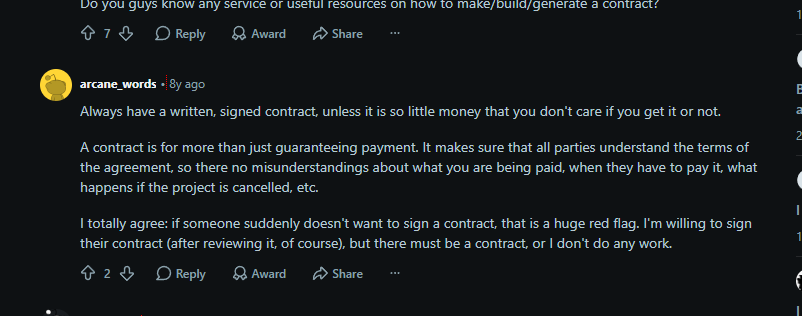
When I see people say something like this, I tend to think their mental model of nonpayment around a contract is roughly:
Client: I’m not paying you $5,000.
Vendor: “I cast contractus ENFORCICUS!”
Client: Oh no, $5,000 just disappeared from my checking account!
(This mental model is only bolstered by the fact that the redditor goes by “arcane words”, though, to avoid dumping on them too much, they do have a good point about contracts preventing misunderstandings, which I’ll talk about later.)
But the contract causing the payments is not actually what’s happening. To understand, consider that every morning I play the Wordle right when I wake up, and every morning, Jupiter fails to slam into Earth. As much as I’d like to think that I’m an interplanetary superhero, what’s really going on here is correlation, and not causation.
That’s also what’s happening to arcane_words. Their clients have, presumably, always paid, and they have presumably, always had a contract. Like Wordle and Jupiter, those things are probably not related. Clients mostly pay. Business commonly involves contracts.

Let’s take a detailed, realpolitik look at how contracts actually work in practice and why enforcement isn’t really a thing for freelancers.
Small Clients May Be Judgement-Proof
First, it’s worth understanding that a decent cross-section of the business population is, for all intents and purposes, judgement proof. I am not super clear on whether this is a legal term of art or not, but the general idea is that some potential defendants don’t have any money. Meaning, you could sue them for $1 billion, win, have a judge order them to pay, but they still don’t have any money.
This might come up most commonly if you hire someone off of Craigslist to do some work on your house, give them a deposit and have them subsequently ghost you after spending your deposit money on booze and lottery tickets, even though they totally meant to buy the materials for the job. You could sue this person. You would probably win. They would still be a penniless derelict.
In a B2B sense, there is something else at play.
A lot of non-equity businesses, like those of the freelancers talking about contracts, are literally worthless from an equity and value perspective. I don’t mean this in the pejorative sense. I mean that if a freelancer incorporates an LLC (you absolutely should do this — I don’t thumb my nose at all bureaucratic precaution) and then simply passes all money received from clients to their personal bank account as income, that business has no assets.
And if you sue a business with no assets (assuming the founder didn’t pierce the corporate veil), there’s not a lot of blood to wring from the stone. So it is entirely possible for you to transact non-trivial amounts of business with people and entities against whom you would have no practical legal recourse. This is quite likely the case with the OP in the reddit thread, where it sounds like 3 parties with no idea how anything works were threatening to sue each other in spite of all of them almost certainly being judgement proof.
(As an aside and perhaps a topic for another day or the comments section, I would argue that threatening a lawsuit against someone you’re negotiating with is a profoundly unserious tactic.)
Small Contracts are Literally Not Worth Legally Enforcing
Alright, so say you have a payment or scope dispute and the other party is not, in-fact, judgement proof. They are imminently… judgement-able? Judgment-friendly? Is that a thing? Anyway, they have money.
Here’s a second hurdle with potential litigation around a contract as an enforcement problem. There is a decent chance, especially in the freelance world, that recovering the amount in question via litigation would have negative return on investment.
My attorney once ballparked for me that to sue someone, at least in that venue at the time we were talking, you would want to be going after $25K in damages at a bare minimum. The specific amount doesn’t matter that much here for understanding the principle. What you need to understand is that you’re probably going to spend something like $15K or $20K on the litigation process itself: filing the complaint, correspondence, mediation, depositions, etc.
So if you sue someone for $5K, and it goes to litigation and you win, congratulations — you just won enough to pay a quarter of your legal bills. Now, before you object with “I’ll sue them for attorneys fees” you should go actually look up the extent to which that’s possible, versus the degree to which you’re assuming it based on an episode of Suits.
(As a brief aside, small claims courts are a possibility, but claims caps vary by state and there is a definite valley of despair where a claim is too large for small claims, too little for litigation.)
Larger Clients Will Just Politely Tell You to @#$& Off
To make matters worse, serious entities — the kind that aren’t shrieking about lawsuits — understand this math. Meaning, if you shriek at them that you’ll sue for $5K and they understand the landscape, they’ll simply respond, “best of luck with that, Karen.”
(FWIW, I would personally actually respond with something like, “I’m sorry you feel that way, but at this point please direct any communications to my attorney.”)

But let’s now move on to what happens when you’re dealing with a large, resourced client for an amount over which a lawsuit would not get you upside down. You believe they owe you, say, $100K.
I should say here that this is getting into somewhat speculative territory for me. I have never in my life dealt with non-payment from a client, in spite of working with and without contracts for substantial sums of money. So what I’m saying here is more about what a larger organization could do from a game theory perspective than what I’ve observed. And I believe that’s fine here, since I’m trying to explain the uphill battle you face in saber rattling at an enterprise about a contract.
A large organization that agrees with your assertion that you performed work for them WILL pay you. That’s just what they do. Wordle-Jupiter stuff.
But a large organization that believes they do not owe you money can, and should, contract or no, just ignore you.
It’s going to cost you, dear freelancer, a $2K retainer just to get a good attorney to review the contract to see if they agree with your read of it. And since until you take that step, nothing you do from a legal perspective really matters, the move is simply to ignore you until they receive correspondence that you’ve retained an attorney.
(This is also why huffing and puffing about lawsuits is silly — if you were actually serious, they’d hear about a potential suit from your attorney.)
Larger Clients Have Asymmetric Resources
And this issue of the size of your wallet is extremely important in understanding the practical realities of a potential lawsuit. You might think of contracts and the law as black and white issues of right and wrong, but I would abandon this outlook entirely and think of them, instead, as a game, in the game theory sense. There isn’t right or wrong, just odds, possible outcomes, and cost-benefit analysis.
You may fervently believe you are in the right. Most people may agree with you. All that really means is that if you spend $20K on litigation in pursuit of your $100K, and it goes all the way to judgement, you have a 95% chance of winning.
If you find this objectionable, I certainly understand, but you need to know that this is how the people you’re up against are looking at things. They’ll ignore you until you retain an attorney, since odds are you won’t. They’ll mostly ignore you and your attorney, offering a nuisance settlement amount, until you file suit. And they’ll take their time the entire way.
The reason they’ll do all of this is because they understand that the $20K legal fees that are a rounding error to them are backbreaking to you. They will use this, hard, against you. And it won’t even be personal — it’ll just be the SOP for dealing with a nuisance lawsuit, which they deal with constantly.
You’re basically playing poker at a table where the ante is your entire bankroll, and the other player has deep pockets. That’s a terrible position.
Let’s Game This Out, Paper Tiger
To wrap on the enforcement problem and really drive the point home, let’s actually game this out. Say you bring your contract to Giganticorp and demand that they sign it in order to do business with you.
The first issue is that they will respond with:

More specifically, they will have a vendor agreement that you have to sign or redline. It’s exceedingly rare for a large organization to work with your agreement, unless you’re offering something highly specialized with specific rules of engagement. And, even if they agreed to use your contract as the starting point, they would redline it beyond all recognition.
But let’s then say that everyone signs on the dotted line, you get to work, and you do what you believe to be $100K worth of work. The company disagrees and says they won’t pay.
You threaten everything you can think of: late fees, additional invoices, sending them to collections, lawsuits, etc. They just keep blowing you off. Maybe they refer you to their staff counsel, or maybe they just ignore you completely.
What are you really, actually going to do here? I mean, you’ll probably do what I would recommend, and reach out to an attorney to ask what your options are. But what will you do when the attorney says “we could fight this, but I’ll need $2K to get started?” Or “your case is decent, but you’re going to spend $20K and 16 months for maybe a 60% shot at winning.”
In the end, all the contract really does is make that shot at winning or settling a 60% chance, instead of a 40% chance.
How Contracts DO Help
Alright, so I’ve spent a lot of words telling you that contracts are not, in your situation, a meaningful enforcement lever. And hopefully I’ve made my point. Now I’ll switch gears and talk about how contracts can actually be useful for you, and an asset for you.
Types of Contracts
First, though, I want to talk a little bit about the types of contracts that are likely relevant to you in a services business. When I see freelancers vaguely talk about contracts, I think they’re probably referring to one mishmash document that kind of covers everything. But in reality, here are the contracts I would suggest having at your disposal in some form or another.
- A mutual non-disclosure agreement (NDA). This is an agreement where you and your client agree not to disclose confidential information that comes up in your collaboration to other parties. I like it as a standalone agreement.
- A master services agreement (MSA). This is the one that contains the stuff you’re probably most worried about: payment terms, intellectual property ownership, assignment, and generally the rules of engagement for how you conduct mutual business.
- A Statement of Work (SoW). You will generally have multiple SoWs under your overarching MSA, and they get into specific deliverables, artifacts, and milestones.
There are certainly other types of agreements that may be relevant to your practice at times, but these are the ones that I would recommend having at the ready. The NDA will basically never change, the MSA might evolve with your practice and per-client (and clients will absolutely mark if they don’t simply supply their own), and the SoW is a template that changes per-project.
In this day and age, you can probably have Chat Gippity make you a decent one of each as a starting point. I’d advise that, rather than spending a bunch of money on legal fees, unless you and your practice are large enough not to be functionally judgement-proof. Otherwise, a billable hour or two with an attorney can help you nail these down.
If you think I’m being too cavalier about this, I would remind you, again, that clients will rarely agree to use your paper.
Now I’ll lay out the benefits of this approach, none of which is your contractus enforcicus spell.
Benefit 1: Disqualifies Shady Operators
First, in a nod back to arcane_words, a client that won’t agree to some form of services contract is a smell. After all I’ve said about contracts sucking as a collection mechanism and the fact that I happily transact business without contracts in plenty of situations, this probably sounds odd. Let me explain the nuance using Hit Subscribe as an example of a client, since we’ve worked with hundreds of freelance contractors.
If a prospective author came to us and said, “I’m happy to create some content for you, but only if you agree to my contract,” we would decline. But we wouldn’t decline out of an aversion to putting (digital) pen to paper. THAT would be shady. We’d decline because we have a standard author agreement and that’s what we use. Hit Subscribe is an excellent example of what I’ve been saying about clients already having stock services agreements that they use.
So if you present a contract to a client and they decline because they have their own well-documented process and contract, that’s normal. If they lack that and just don’t want to sign something, that’s a yikes. I’d fire a prospect like that without hesitation.

Benefit 2: Forces Discussion of Conflict Points Up-Front
Few conversations have as many good vibes as good-fit sales calls and kickoff calls. When two parties have agreed to work together, they see tons of potential, are engaging in subconscious choice-supportive bias and envision the happiest of happy paths.
With these vibes flowing, it’s the easiest moment to gloss over potentially serious misunderstandings. The contractor handwaves “you guys are a big, established company, I’m sure you pay in timely fashion.” And the client hand-waves “you’re a pro, so you obviously know NET-60 is standard with a company like ours.” These two parties each have good intentions while harboring wildly different conceptions about enterprise vendor payment terms.
A contract nips that kind of thing in the bud. That same contractor would scan through the client’s MSA and ask, “hey, what does this NET-60 mean,” prompting mutual understanding before things could ever become contentious. The terms of engagement, spelled out clearly up front, force both parties to confront sources of conflict and bad-fit.
Benefit 3: Saves You Some Redline Labor
The first two benefits apply to anyone’s paper: yours or the client’s. Let me now explain a couple of benefits of having your agreements. The first one is subtle, but I’ve found to be great over the years. And that is having your own contract, which contains your rules of engagement, makes negotiating an agreement on client paper much easier.
In a scenario where you have no agreement, each client contract or consulting agreement you sign becomes a labor-intensive redlining slog for you. Having your own agreement can help you keep negotiating points clearer in your own mind if you’re doing the redline. But crucially, life-hack alert: if you send your own agreement over preemptively, their legal team might actually save you the effort and mark up the contract themselves, incorporating your terms.
Benefit 4: Used Right, You Profile as a Sophisticated Vendor
A second benefit to having your own set of agreements is, assuming you conduct yourself reasonably, the optics.
There are a couple of things it’s pretty common for me to say when discussing a potential engagement for Hit Subscribe. First, I often find myself saying, “hey, if you want me to take a deeper look at your situation, you can share your GA4 and GSC with us, and we’ll instrument Osiris to do a deeper dive. Happy to shoot over a mutual NDA and instructions for sharing access.”
Second comes up when we’re talking to mid-market and larger companies that put us in the services bucket and tell me they have a vendor agreement. “I’ll send along a list of typical redline points for your legal folks to consider. For instance, you’ll likely have something in there about written permission for assigning work to subcontractors, but we use a lot of subs, so we redline that to prevent you from an endless string of assignment requests.”
I’m not using these examples to toot my own horn or claim that we’re super slick or whatever. But if you think about the impression this creates with a prospect, if nothing else they will correctly conclude that this isn’t our first rodeo. We do enough business that an NDA and redline provisions are something I can rattle off effortlessly.
But it has a second, perhaps subtler effect, as well. Prospects rarely think of an NDA when talking about adding me to their analytics. We’re proactively thinking of, and offering paper around, something that protects them. And your contracts and agreements should absolutely be about preserving your clients’ best interests as a secondary goal to preserving your own.
The Real Purpose of a Contract
So in the end, should you have a contract or not?
I personally default to not bothering with contracts in a lot of contexts, including my indie management consulting days. In the enterprise, I’d sign theirs, when none was presented, I’d usually just shoot over a short proposal doc and get going. And this was because I had, and have, other tactics to de-risk from a concern like non-payment. Invoicing up front takes care of this entirely, for instance.
Whether you bother with having contracts or not, it’s critical to understand their real value and useful scenarios. A contract can serve several interesting purposes: a sales asset, a mode of documentation, a discussion starter, a business qualification data point. But as for serving as leverage and enforcement of payment terms, especially for freelancers and small businesses, that really isn’t where it shines.
So use contracts where they’re useful. And have other means of de-risking non-payment and enforcing your rules of engagement. Because if you don’t, you’ll wind up discovering just how little leverage your contract creates at the exact time you need that leverage the most.
